
Excessive heat can affect private Southern Maryland water wells, especially when high temperatures arrive with limited rainfall and increased household water use. Heat does not usually damage the underground well itself. Instead, drought conditions can reduce groundwater recharge while lawn watering, pool filling, laundry, and other demands increase pumping. Shallow or low-yield wells may experience pressure loss, air in plumbing, sediment, cloudy water, or temporary water interruptions. Homeowners can reduce risk by spreading out water use, limiting irrigation, monitoring changes, and scheduling service when warning signs appear. Prompt attention can prevent pump damage and help restore a household water supply.
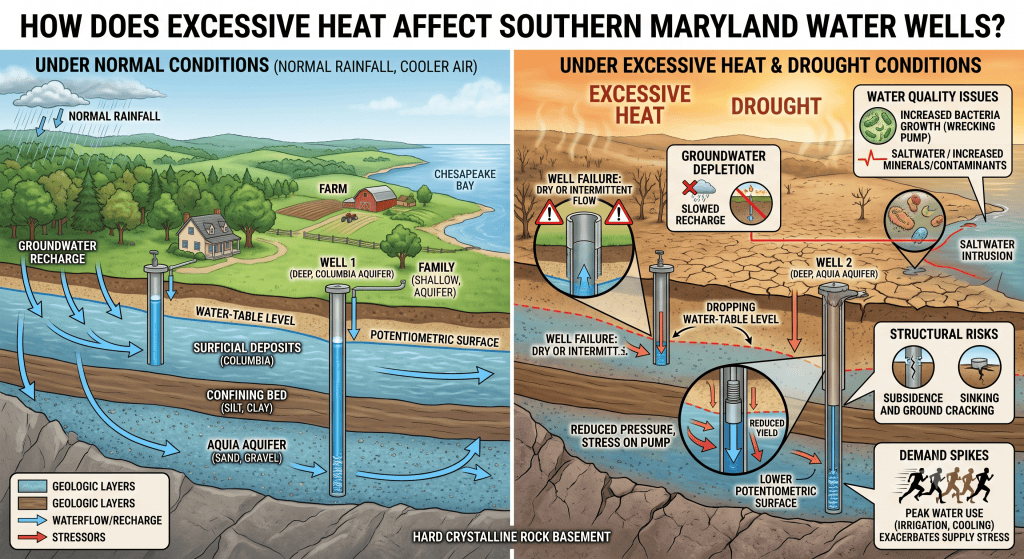
Long stretches of hot weather can put added stress on Southern Maryland water wells. The temperature above ground is not normally hot enough to damage a properly constructed underground well. The greater concern is what often comes with excessive heat: reduced rainfall, slower groundwater recharge, and higher household water demand.
During a hot, dry period, families often use more water for outdoor irrigation, gardens, livestock, pools, showers, and laundry. When groundwater levels are already declining, that extra pumping can expose weaknesses in a low-yield well, an aging pump, a pressure tank, or another part of the water system.
Can Excessive Heat Directly Damage a Residential Well?
Excessive heat usually does not directly heat the underground water or damage the well casing. Most Southern Maryland water wells draw from groundwater located far below the surface, where temperatures remain relatively stable.
However, heat can indirectly affect the system. Hot weather increases evaporation from soil and surface water. When rainfall is limited, less water reaches the ground and replenishes the aquifers supplying Southern Maryland water wells. At the same time, households may pump considerably more water. That combination can lower available water levels and cause a marginal well to struggle.
The pump and electrical components can also work harder when demand rises. A pump that runs for long periods without adequate water may overheat, wear prematurely, or suffer damage. The result may appear to be a heat-related failure even though the underlying problem is insufficient water entering the well.
Why Can Hot, Dry Weather Create Well Problems in Southern Maryland?
Southern Maryland is part of Maryland’s Coastal Plain, an area underlain by layers of sand, gravel, silt, and clay. Southern Maryland water wells may draw from different aquifers and at different depths. Because construction, depth, age, and yield vary from property to property, Southern Maryland water wells do not all respond to drought in the same way.
Shallow wells are generally more responsive to recent rainfall conditions. Deeper wells may be less affected by a brief dry spell, but they can still experience pressure changes or increased drawdown when many nearby users pump heavily. A well that has always supplied a home adequately may begin showing problems during an unusually hot summer if demand exceeds its recovery rate.
Maryland officials encourage private-well owners to conserve water during drought conditions, particularly when a well draws from a shallow aquifer. Groundwater can recover slowly after extended rainfall deficits, so one heavy storm may not immediately restore normal conditions.
Which Residential Wells Are Most Likely to Be Affected?
The greatest risk typically involves shallow, older, damaged, or low-yield Southern Maryland water wells. A well may also be more vulnerable when the pump is installed too close to the water level, when sediment has reduced well performance, or when the household has added occupants or water-using equipment since the well was installed.
Common risk factors include:
- A shallow well or older dug well
- A low recovery rate or limited well yield
- An aging or improperly sized well pump
- A failing pressure tank or pressure switch
- Heavy irrigation, pool filling, or livestock demand
- Several large water uses occurring at the same time
- Nearby residential, commercial, or agricultural pumping
A licensed professional can evaluate Southern Maryland water wells by measuring the static water level, pumping water level, recovery rate, and system pressure to determine whether the problem comes from groundwater conditions or failed equipment.
What Warning Signs Should Homeowners Watch For?
Problems with Southern Maryland water wells often begin with small changes. Homeowners should pay attention to anything unusual rather than waiting for the water to stop completely.
Warning signs in Southern Maryland water wells may include:
- Lower water pressure, especially during showers or laundry
- Water pressure that rises and falls
- Air or sputtering from faucets
- A pump that runs continuously
- Rapid pump cycling
- Cloudy, sandy, rusty, or discolored water
- Changes in taste or odor
- Temporary loss of water followed by recovery
- Unusual noises from the pump or pressure tank
These symptoms do not always mean the well is going dry. They can also indicate a leaking pipe, clogged filter, weak pump, waterlogged pressure tank, damaged check valve, or electrical problem. A proper inspection is the fastest way to identify the real cause.
Can Heavy Household Water Use Make the Problem Worse?
Yes. Heavy use can temporarily exceed the amount of water entering a well. This is especially important for low-yield Southern Maryland water wells, which may produce enough water for normal household needs but cannot support several high-demand activities at once.
For example, running a lawn sprinkler while filling a washing machine, taking multiple showers, and operating a dishwasher may pull water from the well faster than it can recover. The pressure may fall, air may enter the plumbing, or the pump may run continuously.
Homeowners can reduce stress on Southern Maryland water wells by spreading major water uses throughout the day. Irrigation should be limited during drought conditions, and pool filling should be scheduled carefully. A well needs recovery time. It is a water supply system, not an underground fire hydrant.
How Can Homeowners Protect Their Well During Excessive Heat?
A few practical steps can help protect Southern Maryland water wells during hot and dry weather:
- Repair leaking toilets, faucets, and outdoor spigots promptly.
- Run dishwashers and washing machines only with full loads.
- Avoid doing several loads of laundry back-to-back.
- Schedule showers and other high-demand activities at different times.
- Reduce lawn watering and other nonessential outdoor use.
- Do not fill a swimming pool from the well without professional guidance.
- Check filters and water-treatment equipment for restrictions.
- Watch the pressure gauge and listen for unusual pump operation.
- Schedule an inspection when pressure or water appearance changes.
Routine maintenance for Southern Maryland water wells is especially valuable before peak summer demand. Grove & Son provides water well service, pump repair, inspections, and water treatment services throughout Southern Maryland.
Can Excessive Heat Affect Well-Water Quality?
Heat alone does not necessarily contaminate groundwater. However, a change in water level or increased pumping can disturb sediment and minerals. That may cause temporary cloudiness, sand, iron staining, or changes in taste and odor in some Southern Maryland water wells.
Changes in appearance do not prove that the water is unsafe, but they should not be ignored. The Maryland Department of the Environment recommends annual testing of private well water and additional testing whenever there is a change in odor, taste, or appearance. Testing should be completed by a state-certified laboratory.
Do not assume a treatment system will solve every problem. Sediment may come from the well, pump, piping, pressure tank, or treatment equipment. For Southern Maryland water wells, the source should be identified before equipment is replaced.
When Should You Call a Professional Well Service Company?
Owners of Southern Maryland water wells should call for service when water pressure drops suddenly, the pump runs continuously, sediment appears, faucets sputter, or the home temporarily loses water. Continuing to operate a pump without an adequate water supply can cause expensive damage.
A professional evaluation of Southern Maryland water wells may include checking the pump, pressure tank, pressure switch, electrical controls, plumbing, static water level, pumping level, and well recovery rate. This information helps distinguish a groundwater shortage from a mechanical problem.
The well-completion report can also provide useful information about well depth, casing, screen, original yield, and construction. Maryland well owners may obtain this record through their county health department by using the well tag number attached to the casing.
What Should You Do If Your Well Stops Producing Water?
Turn off unnecessary water-using fixtures and appliances. If the pump is running without producing water, shut off power to the well system to reduce the risk of pump damage. Do not repeatedly reset breakers or pressure controls without knowing why the system stopped.
Some Southern Maryland water wells recover after water use stops, but temporary recovery does not mean the problem has been solved. A pump, pressure tank, control, leak, or low-yield condition may still require attention.
Grove & Son Well Service & Repairs serves Charles County, St. Mary’s County, Calvert County, and surrounding Southern Maryland communities. For prompt assistance, call (240) 538-7074 or contact Grove & Son online.

Frequently Asked Questions About Heat and Residential Wells
Can Southern Maryland water wells completely dry up during a heat wave?
A short heat wave usually does not cause a properly constructed well to dry up. The risk increases when excessive heat continues alongside prolonged drought, declining groundwater levels, heavy pumping, or an already low-yield well.
Will Water Return If I Stop Using It for Several Hours?
Water may return after the well has time to recover. However, repeated interruptions indicate that the well system should be inspected. Temporary recovery may hide a low-yield condition or a pump problem.
Should I Water My Lawn With Well Water During a Drought?
Nonessential irrigation should be reduced when groundwater conditions are stressed. Lawn watering can place substantial demand on Southern Maryland water wells, especially when combined with normal household use.
Does Low Water Pressure Always Mean the Groundwater Level Is Low?
No. Low pressure can result from a failing pump, clogged filter, leaking pipe, pressure switch problem, waterlogged tank, or another mechanical issue. Testing the complete system is necessary before reaching a conclusion.
Sources
- Maryland Department of the Environment. (2026, May 14). Maryland Department of the Environment issues drought warning for large areas of the state due to persistent rainfall deficits. https://news.maryland.gov/mde/2026/05/14/maryland-department-of-the-environment-issues-drought-warning-for-large-areas-of-the-state-due-to-persistent-rainfall-deficits/
- Maryland Department of the Environment. (n.d.). Be Well Wise. https://mde.maryland.gov/programs/Water/Water_Supply/Pages/Be_Well_Wise.aspx
- Maryland Geological Survey. (n.d.). Information about your well. https://www.mgs.md.gov/groundwater/well_information.html
- Maryland Geological Survey. (2022, May 17). Ground water and wells in the Maryland Coastal Plain. University of Maryland Extension. https://extension.umd.edu/resource/ground-water-and-wells-maryland-coastal-plain
- U.S. Geological Survey. (n.d.). Groundwater information: Maryland, Delaware, and the District of Columbia. https://md.water.usgs.gov/groundwater/

0 Comments