
A submersible water pump for a well spends its entire working life underwater, out of sight and out of earshot. That is much of the appeal. There is no pump house to insulate, no above-ground unit to prime, and no suction line struggling to hold its pull. The trade-off is that when something goes wrong, you cannot walk over and look at it. Understanding what the pump does, how it’s sized, and which symptoms point to replacement is the difference between a planned swap and a cold shower with no warning.
What Does a Submersible Water Pump for a Well Do?
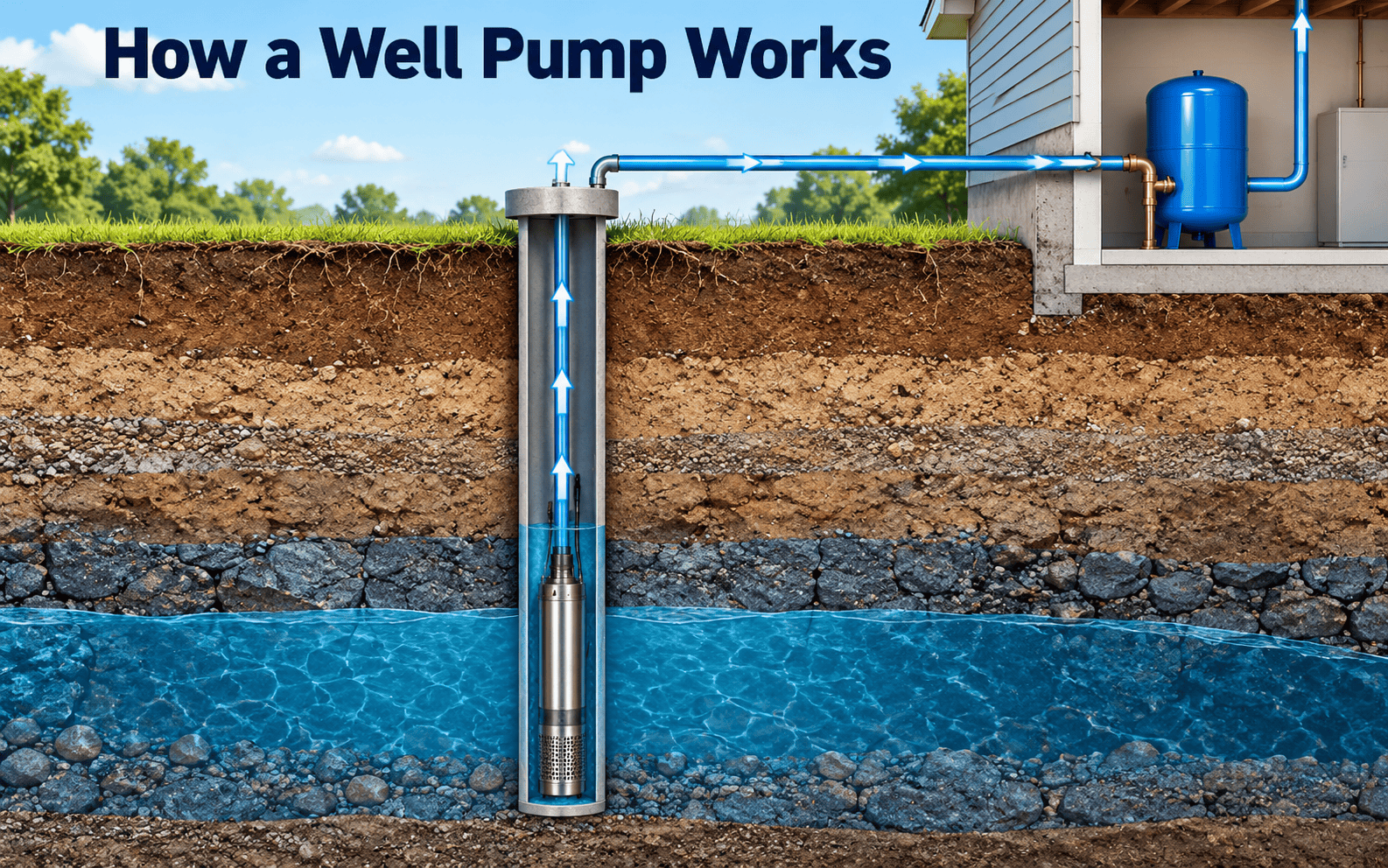
The job is simple to describe: lift water out of the ground and push it into the home’s plumbing under pressure. Because the pump sits inside the well casing below the water line, it pushes water up rather than pulling it. That is a meaningful difference. A pump that pushes does not have to create a vacuum strong enough to draw water from depth, which is why submersible pumps work in settings where an above-ground pump would struggle.
Submersible pumps are the standard choice for deep wells, generally those running 75 feet or deeper, and they are built to handle far more than that. Deep well jet pumps and submersible pumps together cover wells from roughly 25 feet to several hundred feet, so depth alone does not decide the pump type, but it narrows the field quickly.
How a Submersible Well Pump Works
Water enters, impellers spin, pressure builds
Inside the pump housing, a sealed motor turns a stack of impellers. Each impeller adds a small amount of push, and the stages work in series so that the pressure builds as water moves upward through the pump body. This is why multi-stage pumps can deliver steady, higher pressure from a deep setting. Build quality matters at this stage of the game: some pumps use eight-stage thermoplastic impellers inside stainless steel housings designed to resist rust and corrosion, which is exactly what you want in a component that may sit in water for years without being seen.
The trip from the well to the pressure tank
Water leaves the top of the pump and travels up a drop pipe to the pressure tank inside the house. A check valve near the pump holds water in the line when the motor shuts off, so the system does not have to start from empty every cycle. A pressure switch reads the tank pressure and signals the pump to start at the low set point and stop at the high set point. The tank itself acts as a buffer, storing pressurized water so the pump is not cycling on and off every time a faucet opens.
Why the motor lives underwater
The motor is sealed against water but cooled by it. Water flowing past the motor housing carries away heat, which is one reason pump placement matters. A pump set too high in the well, or a well whose water level drops below the pump during heavy use, can leave the motor running hot with nothing to cool it. That kind of stress does not usually announce itself. It shows up later as a pump that quits without much warning.
Submersible vs. Jet Pumps: Matching the Pump to Well Depth
Depth is the first filter when a pump is being selected. The table below shows the general ranges the equipment is built for.
| Well situation | Typical pump type |
| Shallow water table, well under 25 feet | Shallow-well jet pump |
| Well over 25 feet, up to several hundred feet | Deep-well jet pump or submersible pump |
| Deep well, roughly 75 feet or more | Submersible pump set below the water line |
Both deep-well jet pumps and submersible pumps can handle wells from 25 feet to several hundred feet. The difference is where the hardware lives. A jet pump keeps its motor above ground, which makes it easier to service, but it relies on suction to start the process. A submersible unit puts everything in the well, including the motor, which keeps the noise outside and removes priming from the equation entirely.
Sizing a Submersible Pump: Flow, Head, and Horsepower
Three numbers drive the selection. The first is flow, measured in gallons per minute. The second is head, which describes how high and how far the pump has to move water, including the lift from the well and the friction of the pipe run. The third is horsepower and voltage, which determine whether the pump can actually deliver the flow you need at the head you have.
For residential use, pumps in the 9, 15, and 23 GPM range are generally sufficient. Larger flow rates of 30, 45, 70, 80, and 90 GPM are more suited to industrial or agricultural applications. A useful rule is that the pump should be able to push more water than above-average household use will require, so it keeps up on laundry day instead of falling behind.
Voltage and diameter round out the picture. Many residential pumps are 4-inch diameter units built for 230V single phase power, while three-phase 230V and 460V models exist for heavier duty work. Manufacturers publish horsepower alongside flow, so a 3/4 HP, 230-volt, 12 GPM pump and a larger unit can be compared on paper before anyone touches the well cap. Matching the pump to the well and the house is the whole exercise.
Signs a Submersible Pump Is Nearing the End
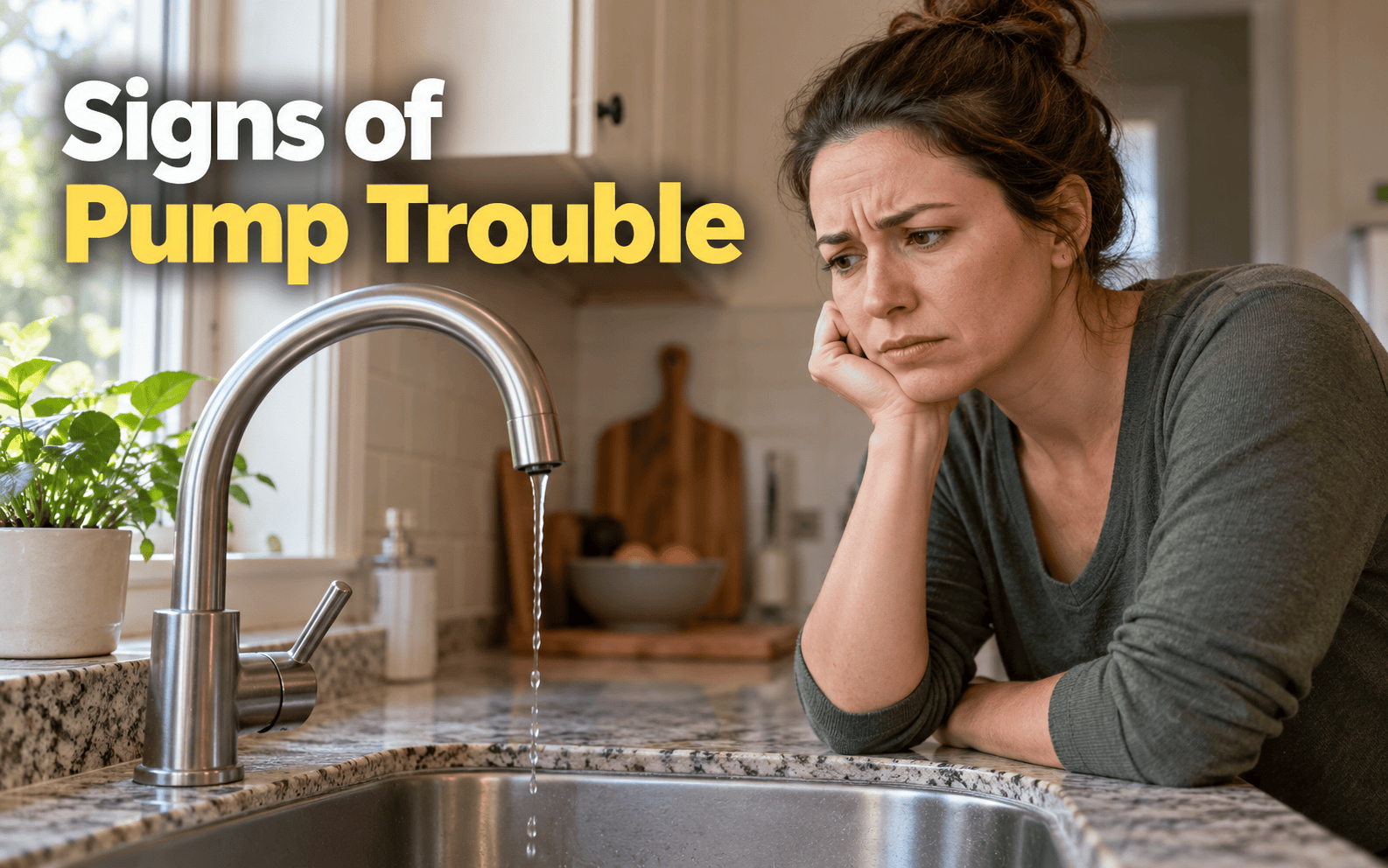
Submersible pumps do not fail on a schedule anyone can plan around, and there is no single service life that fits every well. What you can track is behavior. Watch for these patterns:
- Water pressure that drops gradually or surges between fixtures
- The pump running noticeably longer for the same chores
- Air sputtering at the tap or cloudy water after the system sits
- Sediment or grit showing up in the water
- Breakers tripping when the pump kicks on
- Banging or clicking from the pipes or pressure switch
- No water at all, with the system unable to hold pressure
Not every one of these points to a dead pump. A waterlogged pressure tank, a failed pressure switch, a stuck check valve, or a dropping water table can all mimic pump failure. A well inspection sorts out which component is actually at fault before anyone quotes a replacement. That step is worth taking, because pulling a pump to find out it was a $40 switch all along is an expensive way to learn.
Submersible Water Pump for a Well: What Replacement Involves
Replacing a submersible pump is a pulling job. The pump, drop pipe, wiring, and safety rope come up out of the well, and the new assembly goes back down in their place. The first step, always, is killing the power at the breaker and confirming it stays off for the duration of the work.
The physical side is not trivial. The assembly is heavy, the wiring has to be spliced and sealed correctly, and the pump has to land at the right depth in the well. It is also the moment to look at everything else in the system: the pressure tank, the pressure switch, the check valve, the wiring, and the condition of the well itself. If the old pump failed because of sand, corrosion, or a water level that has changed over the years, dropping in a new pump without addressing the cause tends to lead to a repeat visit.
Getting More Years Out of a Submersible Pump
Most of what shortens a pump’s life happens quietly. Keeping the pressure tank properly charged reduces short cycling, which is easier on the motor than repeated rapid starts. Paying attention to grit or sediment in the water is worthwhile too, since abrasive material moving through a pump wears the impellers. If the well has been showing signs of stress during dry stretches, having the system checked before the pump starts running dry is cheaper than replacing it afterward. Periodic well inspections catch those conditions early.
Submersible Pump Service in Southern Maryland
Homeowners across Charles, St. Mary’s, and Calvert counties rely on private wells, and the pump is the one piece of equipment they notice only when it stops. Grove & Son Well Service & Repairs handles submersible and jet pump installation and repair, along with well inspections, water testing, and treatment systems for iron, hardness, and other water quality issues. A well inspection, available as a $125 offer, is a reasonable first step when pressure starts acting up and you want to know whether the pump, the tank, or the well itself is the source of the problem.

Frequently Asked Questions
How deep is a submersible pump set in a well?
It sits below the water line, deep enough to stay submerged even when the water level drops during heavy use. The exact setting depends on the well’s total depth, the static water level, and the length of the pump assembly. A contractor sets it based on the actual well, not a universal number, since setting a pump too high risks running it dry.
Is a submersible pump better than a jet pump?
For deep wells, usually yes. Submersible pumps are designed for wells running about 75 feet or deeper, and both deep-well jet and submersible pumps cover wells from 25 feet to several hundred feet. A jet pump keeps its motor above ground and is simpler to service, while a submersible keeps the noise and the priming problems out of the house.
How do I tell if the pump or the pressure tank is the problem?
You often cannot tell from the tap alone. A waterlogged tank, a failed pressure switch, a stuck check valve, and a dying pump can produce similar symptoms, including weak pressure, surging, and short cycling. An inspection that tests each component separately is the reliable way to avoid replacing a pump that was never the issue.
Can a submersible pump be repaired instead of replaced?
Sometimes, but it depends on what failed. Once a pump is pulled from the well, the decision usually comes down to the motor, the impellers, and the condition of the housing. Because pulling the pump is the bulk of the labor, many homeowners choose to replace an aging unit while it is already above ground rather than reinstall it.
What size pump does a typical home need?
Most homes land in the 9, 15, or 23 GPM range, which manufacturers treat as sufficient for residential use. The right choice also depends on head, or how high and how far water must travel, plus the horsepower and voltage available at the property. Larger flow rates of 30 GPM and up are typically aimed at agricultural or industrial work.

0 Comments