
A well pressure tank is an essential part of a residential well system because it stores pressurized water and prevents the well pump from turning on every time a faucet opens. Inside the tank, compressed air pushes water into the plumbing until pressure drops enough for the pump to restart. When a tank becomes waterlogged, loses air pressure, develops a damaged bladder, leaks, or is improperly sized, homeowners may notice pressure swings, short-cycling, or reduced water flow. Recognizing these warning signs can help prevent pump damage and determine when Grove & Son Well Service & Repairs should inspect the system.
For homeowners who rely on a private well, the well pressure tank, or water pressure tank, is one of the most important parts of the water system. It works quietly in the background, helping maintain usable water pressure while reducing how often the well pump starts and stops. Here is the Water Systems Council’s downloadable PDF on the common components of a residential well system: Water Systems Council Well Tank Guide.
When the tank is working properly, you may rarely think about it. When it begins to fail, however, the symptoms can show up throughout the house. Faucets may surge, showers may lose pressure, the pump may click on and off every few seconds, or the system may stop delivering water altogether.
This guide explains what the tank does, how it works with the pump and pressure switch, what can go wrong, and when Southern Maryland homeowners should call Grove & Son Well Service & Repairs.
What Is a Well Pressure Tank?
A well pressure tank is a pressurized storage tank installed between the well pump and the home’s plumbing system. Its job is not simply to store water. More importantly, it uses compressed air to push water through the plumbing and provide a usable supply before the pump has to start again.
Most modern residential tanks use either a bladder or diaphragm to keep the water separated from the compressed air. Older systems may use a plain steel tank without a permanent internal separation.
The tank works together with the well pump, pressure switch, check valve, plumbing, and pressure gauge. If any one of these components develops a problem, the symptoms can sometimes look like a failed tank. That is why diagnosis matters before replacing parts.
How Does a Well Pressure Tank Work?
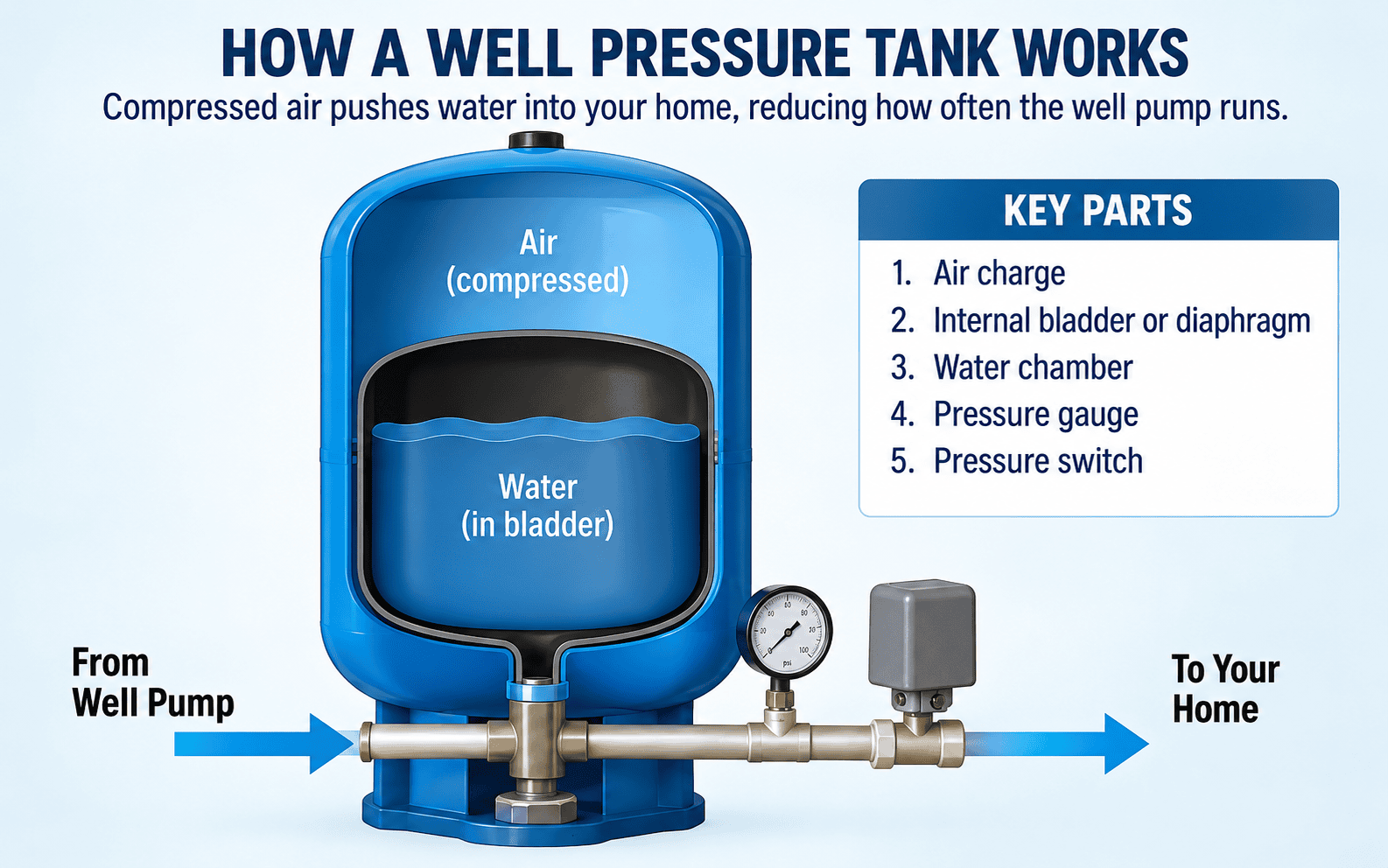 A well pressure tank uses compressed air as a cushion. As the well pump fills the tank with water, the air inside becomes compressed. That compressed air stores energy and pushes water into the home’s plumbing whenever you use a faucet, shower, toilet, washing machine, or other fixture.
A pressure switch controls the system. A common residential setup might operate at 40/60 psi. In that example, the pump turns on when system pressure falls to about 40 psi and shuts off when the pressure reaches about 60 psi.
Between those two settings, the well pressure tank supplies water without running the pump continuously. This usable volume is often called drawdown.
For example, imagine someone fills a glass of water. A properly operating tank may provide that small amount without starting the pump at all. If the tank has lost its air cushion, the same small use could make the pump start almost immediately.
Reducing unnecessary starts is important because repeated starting and stopping creates wear on pump motors and electrical components.
Why Is a Well Pressure Tank Important to the Well Pump?
The well pressure tank protects the pump by reducing how often it cycles. A pump is designed to run, but constant rapid starts and stops can shorten its service life.
Without enough drawdown, even small amounts of household water use can make the pump start. A toilet refill, quick hand washing, refrigerator ice maker, or dripping faucet may cause repeated cycling.
A properly sized and adjusted well pressure tank gives the household a reserve of pressurized water between pump cycles. This helps provide steadier pressure and lets the pump run for longer periods instead of switching on and off every few seconds.
This is why you shouldn’t ignore a tank problem. What begins as annoying pressure fluctuations can eventually become a much more expensive pump repair.
What Can Go Wrong With a Well Pressure Tank?
Several problems can affect a well pressure tank. Some originate inside the tank, while others involve the pressure switch, air charge, plumbing, or pump.
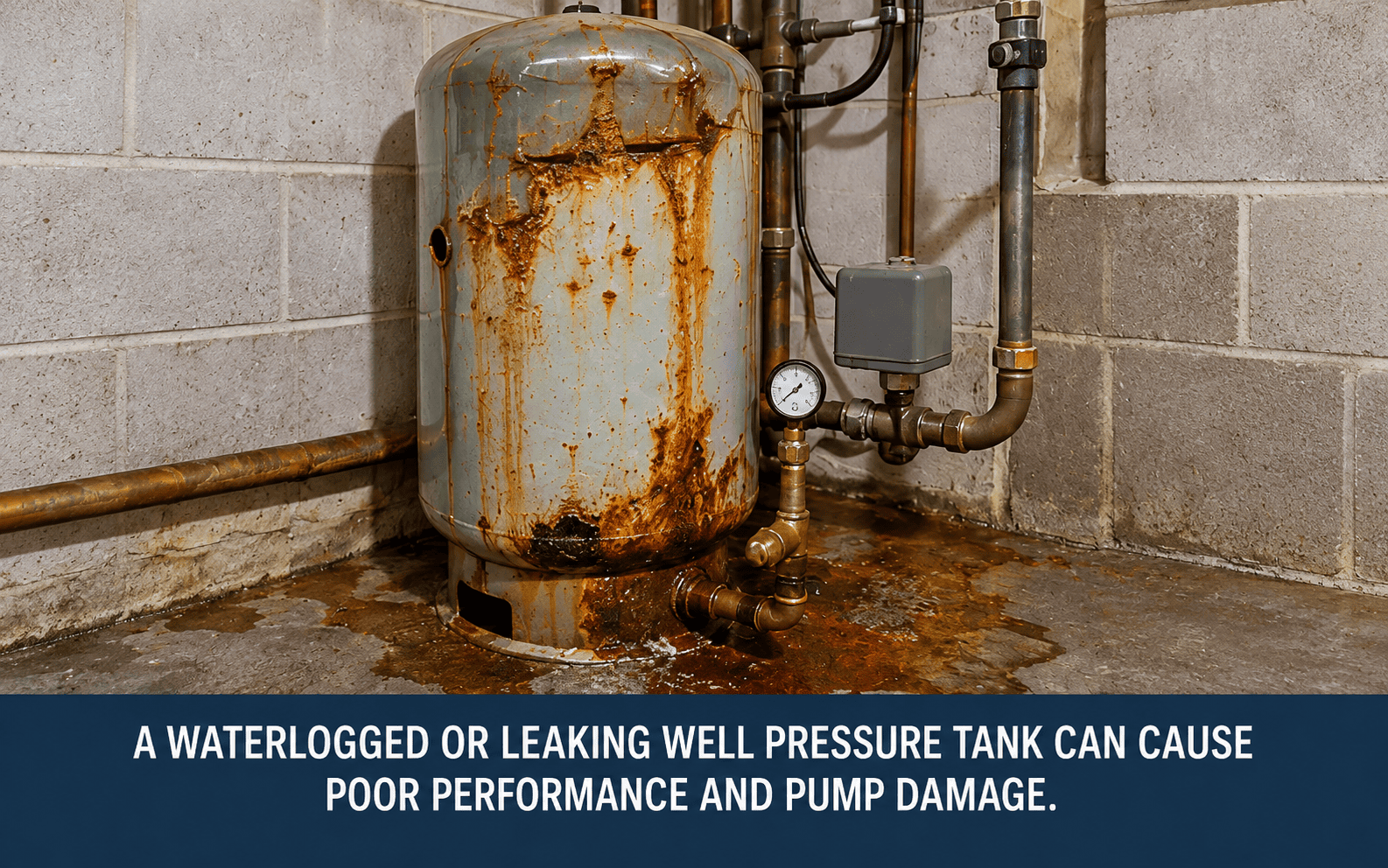 One of the most common problems is a waterlogged tank. In a bladder or diaphragm tank, this can happen when the internal bladder or diaphragm fails, or the tank loses its proper air charge. Without enough compressed air, the tank cannot provide normal drawdown.
Another problem is incorrect precharge. Many bladder-tank manufacturers specify an air precharge approximately 2 psi below the pressure switch cut-in setting when the system is drained and depressurized. For a 40/60 switch, for example, the specified precharge is often around 38 psi. Always follow the tank manufacturer’s requirements.
A well pressure tank can also develop external corrosion, pinhole leaks, damaged fittings, or a leaking air valve. Tanks installed in damp basements, crawl spaces, or utility areas may be particularly vulnerable to corrosion over time.
Finally, a tank may simply be too small for the pump or household demand. An undersized tank provides less drawdown and can allow the pump to cycle more often than intended.
What Does a Waterlogged Well Pressure Tank Look Like?
A waterlogged well pressure tank contains too much water and not enough usable compressed air. The most noticeable symptom is usually rapid pump cycling.
For example, a homeowner turns on a shower. Instead of the pump running through a normal cycle, the pressure gauge may quickly rise to the shutoff pressure, the pump stops, the pressure immediately falls, and the pump starts again. This may repeat every few seconds.
Other symptoms can include surging water pressure, frequent clicking at the pressure switch, and a tank that feels unusually heavy because it contains more water than it should.
If water comes out of the tank’s air valve on a bladder-style tank, that can indicate the internal bladder has failed. A professional should confirm the diagnosis and determine whether replacement is necessary.
Why Does a Well Pressure Tank Cause the Pump to Short Cycle?
Short cycling means the well pump starts and stops too frequently. A failed or improperly charged well pressure tank is a common cause because the system has lost the air cushion that normally stores pressurized water.
Consider a normal 40/60 system. With adequate drawdown, the homeowner may use several gallons before pressure falls from 60 psi to 40 psi and the pump turns on. If the tank is waterlogged, pressure may fall almost immediately when a faucet opens. The pump starts, pressure rises quickly, the pump stops, and the cycle repeats.
Short cycling may also result from a defective pressure switch, a clogged pressure-sensing port, a check valve problem, a leak, or another system fault. Replacing the tank without diagnosing the complete system can therefore waste money and leave the real problem unresolved.
Because rapid cycling can damage a well pump, it is a good reason to call Grove & Son promptly.
Why Does Water Pressure Surge Up and Down?
Surging pressure can occur when a well pressure tank is out of balance with the pressure switch, the tank has lost its proper air charge, or the internal bladder or diaphragm has failed.
A homeowner might notice a strong shower for several seconds, followed by weaker pressure, then another sudden increase when the pump starts. The pressure gauge may move rapidly between the cut-in and cut-out settings.
Pressure fluctuations don’t automatically mean the tank is bad. Pump sizing, a faulty switch, clogged filters, water treatment equipment, plumbing restrictions, and low well yield can also affect pressure.
Grove & Son can inspect the well pressure tank along with the pump, switch, gauge, fittings, and related equipment to determine the actual cause.
What Happens If the Well Pressure Tank Has the Wrong Air Pressure?
Incorrect air pressure can reduce the usable water stored in a well pressure tank and cause poor system performance.
If the precharge is too low, the tank may accept too much water and provide less effective air cushioning. If the precharge is too high relative to the pressure-switch setting, the tank may provide very little usable drawdown, and homeowners may experience an abrupt pressure change as they use water.
The correct precharge depends on the pressure-switch settings and the tank manufacturer’s instructions. Many bladder-tank manufacturers call for a precharge 2 psi below the switch cut-in pressure, measured with the pump power off and the water side fully depressurized.
Because the procedure involves the pump’s electrical supply and a pressurized water system, homeowners unsure of the correct settings should have a qualified well professional check the system.
Can a Well Pressure Tank Leak or Rust?
Yes. A well pressure tank can develop corrosion, leaks, or weakened fittings over time. Investigate visible water around the bottom of the tank, rust streaks, dampness, or recurring puddles.
A small leak can gradually reduce pressure and make the pump run more often. A badly corroded tank may eventually require replacement.
Do not assume water near the tank means the tank shell itself has failed. Leaks can also occur at the tank tee, pressure gauge, pressure switch connection, drain valve, unions, or nearby piping.
For example, a homeowner may see water around the base of the well pressure tank and order a new tank, only to discover that a threaded fitting above the tank was leaking. An inspection can separate a relatively small plumbing repair from a full tank replacement.
How Can a Pressure Switch Problem Mimic a Bad Well Pressure Tank?
The pressure switch tells the pump when to start and stop so that a switch problem can create symptoms similar to a failing well pressure tank.
A worn, clogged, incorrectly adjusted, or electrically damaged switch may cause erratic pump operation. The small passage, or nipple, that lets the switch sense water pressure can also become restricted by sediment or mineral buildup.
Symptoms may include pump chatter, delayed starting, failure to shut off, failure to start, or pressure readings that do not match normal system behavior.
If the pump runs continuously and the pressure keeps rising, or if electrical components buzz, spark, or overheat, shut the system down if it is safe to do so and call a professional. Don’t treat electrical and pressure problems as trial-and-error repairs.
Can a Well Pressure Tank Be Too Small?
Yes. A well pressure tank that is too small for the pump and household demand can allow excessive cycling even when the tank itself is not defective.
Tank sizing depends on several factors, including pump capacity, pressure-switch settings, desired pump run time, household demand, and the amount of drawdown the tank provides.
For example, a larger pump paired with a small tank may fill the available drawdown very quickly. The pump reaches shutoff pressure, stops, and then restarts soon after more water is used.
A replacement tank should be sized for the system, not chosen simply because it fits in the same space as the old one.
When Should You Call Grove & Son About a Well Pressure Tank?
Call Grove & Son Well Service & Repairs when the well pressure tank or surrounding system shows signs that could damage the pump, interrupt water service, or create a leak.
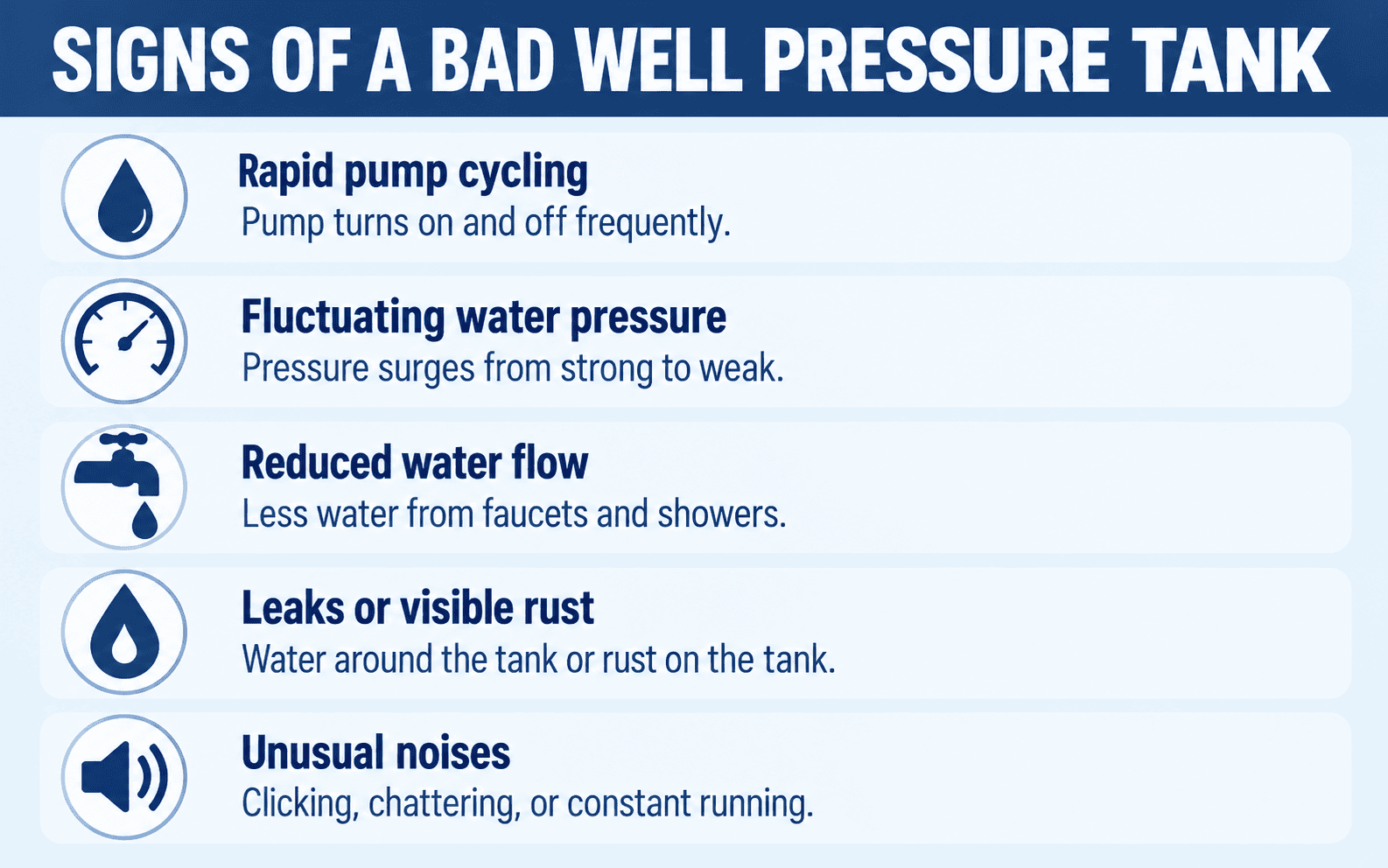 Important warning signs include:
- The pump turns on and off every few seconds.
- Water pressure repeatedly surges from strong to weak.
- The pump runs continuously and does not reach shutoff pressure.
- The pressure switch clicks or chatters repeatedly.
- Water comes from the air valve on a bladder-style tank.
- The tank or fittings are leaking.
- The tank shows substantial rust or corrosion.
- Household water pressure suddenly becomes much lower than normal.
- The pump runs when only a very small amount of water is used.
- The home suddenly has no water.
- A breaker repeatedly trips when the pump operates.
- You are unsure whether the problem is the tank, pump, switch, or well itself.
Grove & Son provides residential water well service and repair, pump installation and repair, and well inspections in Southern Maryland. The company serves Charles County, St. Mary’s County, Calvert County, and surrounding communities and is available 24 hours a day, 7 days a week.

Homeowners can call Grove & Son Well Service & Repairs at (240) 538-7074 when a well pressure tank problem needs professional diagnosis.
Can Grove & Son Determine Whether the Tank or Pump Is the Real Problem?
Yes. Because several well-system problems produce similar symptoms, proper diagnosis can prevent unnecessary replacement of good equipment.
A service professional may evaluate the well pressure tank, pressure switch, pressure gauge, tank fittings, electrical controls, pump operation, and overall pressure cycle. The technician can also consider whether the household is dealing with low well yield, a plumbing leak, a check valve issue, water-treatment restriction, or another problem unrelated to the tank itself.
For example, frequent cycling could be caused by a waterlogged tank, but it could also result from a plumbing leak. Low pressure could indicate a tank issue, but it might instead be a weak pump or clogged filter.
The goal is to identify the cause before deciding whether adjustment, repair, or replacement is the most sensible solution.
What Should Homeowners Remember About a Well Pressure Tank?
A well pressure tank is designed to maintain pressure, provide usable water between pump cycles, and protect the well pump from excessive starting and stopping. Key warning signs include rapid cycling, pressure surges, reduced pressure, leaks, unusual pressure-switch activity, and a pump that runs too often or will not shut off.
Ignoring these symptoms can turn a manageable tank or control problem into a failed pump or loss of household water. For Southern Maryland homeowners, Grove & Son Well Service & Repairs can inspect the system, identify the cause, and recommend the appropriate repair or replacement.
What Are the Most Common Well Pressure Tank FAQs?
How long does a well pressure tank last?
No single lifespan applies to every tank. Water quality, installation conditions, tank construction, cycling frequency, corrosion, pump sizing, and system maintenance can all affect service life. Evaluate a tank by condition and performance, not age alone.
How do I know if my well pressure tank bladder is bad?
Possible signs include rapid pump cycling, large pressure swings, very little drawdown, or water coming from the tank’s air valve. Confirm these symptoms because switch, pump, plumbing, or control problems can cause similar behavior.
What pressure should a well pressure tank be set at?
The required air precharge depends on the pressure switch and manufacturer instructions. For many bladder tanks, manufacturers specify a precharge about 2 psi below the switch cut-in setting, with the water side fully drained and pressure at zero.
Is 40/60 psi a normal well pressure setting?
A 40/60 psi pressure-switch range is common in residential systems. It means the pump normally starts near 40 psi and stops near 60 psi. Other systems may use different settings depending on the equipment and household requirements.
Why is my well pump clicking on and off every few seconds?
A waterlogged well pressure tank, incorrect air charge, a failed bladder, a defective pressure switch, a leak, or another system problem can cause rapid cycling. Because short cycling can damage the pump, investigate the cause promptly.
Can I keep using water if the pressure tank is failing?
The system may continue to deliver water temporarily, but continued rapid cycling or abnormal pump operation can increase pump wear. If the pump cycles rapidly, runs continuously, leaks, or behaves abnormally, professional service is advisable.
Does a larger well pressure tank increase water pressure?
Not necessarily. A larger tank generally provides more drawdown and can reduce pump cycling, but the pressure switch and pump capabilities primarily control system pressure. Tank size and pressure are related but not the same.
Can a bad pressure tank cause no water in the house?
A tank problem can contribute to loss of normal water delivery. Still, no-water conditions can also result from a failed pump, an electrical problem, a pressure switch failure, a broken pipe, a low water level, or another well-system problem. A complete diagnosis is important.
Sources
Amtrol. (n.d.). Well tank support. Retrieved September 22, 2026, from Amtrol Well Tank Support
Grove & Son Well Service & Repairs. (n.d.). Services. Retrieved September 22, 2026, from Grove & Son Services
Water Systems Council. (n.d.). FAQs. Retrieved September 22, 2026, from Water Systems Council FAQs
Water Systems Council. (n.d.). Frequently asked technical questions. Retrieved September 22, 2026, from Water Systems Council Technical Questions
Water Systems Council. (n.d.). Sizing a pressure tank. Retrieved September 22, 2026, from Water Systems Council Pressure Tank Sizing Guide
Water Systems Council. (n.d.). Well components: Your well tank. Retrieved September 22, 2026, from Water Systems Council Well Tank Guide

0 Comments